The Fed likes to maintain the image that it has absolute control over rates and monetary policy. The reality is much more nuanced, as one would expect from a complex system like the financial system. The Fed admittedly has many tools in their toolbox, but the market also plays a strong role. In some regards, the all powerful Fed is like the great & powerful Wizard of Oz, which makes sense given the underlying meaning of that movie. Now stablecoins, like Dorothy, are lifting the curtain to expose the Fed’s waning power.
The Fed wields strong influence over bank lending through tools such as the federal funds rate, interest on reserve balances (IORB), and using its balance sheet for quantitative easing/tightening (QE/QT). While it maintains the facade of total control, the reality is that the market and business cycles play a very large role. Looking at the comparison of the Fed Funds Interest Rate (Fed controlled) to the 3-Month T-Bill (market controlled), it is clear that the market leads the way and the Fed Funds follow the market.
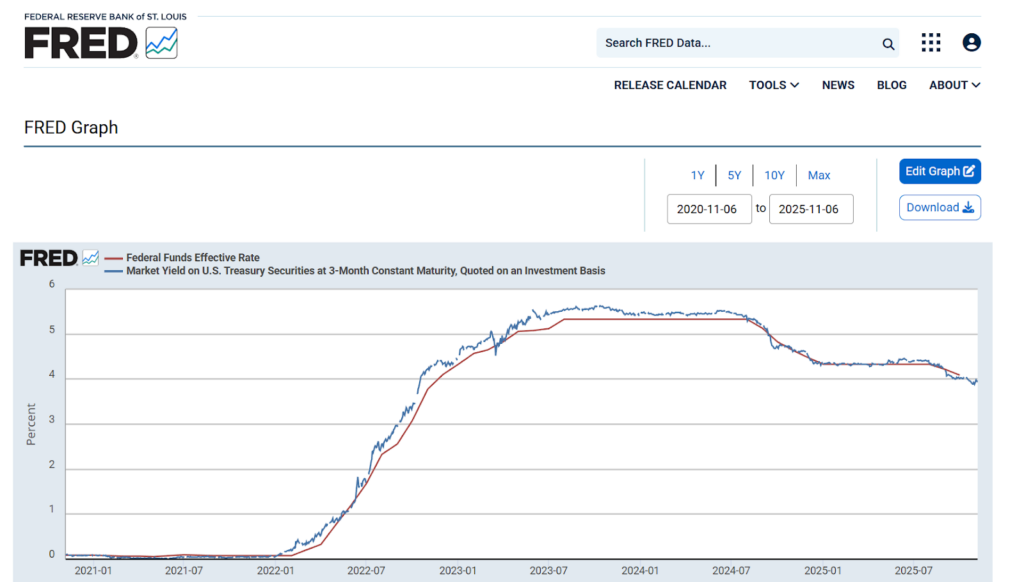
While one could argue that the Fed manipulates the market and the market merely predicts the Fed actions, but aside from a few hiccups, the market always leads.
QE/QT Play a huge role because a firehose of money will find its way into the market and influence pricing and rates. One could also argue that Freddie Mac and Fannie Mae have an outsized effect on the 10-year bond due to their buying of mortgages, but that is another story for another day.
The GENIUS Act is changing the game. By mandating segregation of funds backing the stablecoins, funds are flowing out of bank deposits into stables. This reduces bank reserves which dampens the impact of Fed influence to Interest on Bank Reserves (IOBR), so one Fed tool is muted.
This reduction of bank reserves also reduces bank liquidity ratios which impacts lending, the primary tool for creating new money in the financial system; lending money into existence. This too weakens the Fed’s control over monetary policy.
It also creates a non-economic buyer of treasuries, because the stablecoin issuers buy and hold treasuries and money-market funds to back their stables. They are already huge buyers of treasuries. This could force short-term rates lower, while longer-term rates increase due to bank pullback on lending. This could further neuter the power of the Fed to set Fed Funds Rates, or at least expose the market’s strong influence on rates.
In regards to QE/QT, this appears to be subject to fiscal dominance: meaning that congress is spending a lot and the Fed largely follows the fiscal. Yet another Fed monetary tool that is weakened.
The Fed is also losing the ability to manage the quantity of money, not merely from the muting of its tools but also due to the market's control of stablecoin volume. Basic economics tells us that market price and volume are determined by the intersection of supply and demand. Stablecoins have a fixed price, pegged to the dollar. This means that supply must equal demand at the $1 price. Simply put, the market determines the demand of stablecoins, not some central authority or even the issuers.
Meanwhile, tech companies are using regulatory arbitrage to dominate the issuance of stablecoins leaving banks, thus far, in the cold. With banks being the Fed’s accomplice in extending monetary policy into the economy, this further weakens the Fed’s influence.
Keep in mind that the financial system is a complex system, where no one tool dominates monetary policy. However, the additive effect of these changes appear to all be in one direction: shifting control of monetary policy away from centralized Fed control to more market control.
Stablecoins aren't toppling the Fed's throne—not yet. Their $311 billion scale pales against $20+ trillion in broad money, and GENIUS' yield ban reins in the wildest excesses. But they're nibbling away at the Fed’s perceived power. Like Dorothy exposing the Wizard, stablecoins are exposing the Fed’s growing impotence. Stables aren’t big enough to take down the Fed, but they are growing in size and power, and price is always determined on the margin. I suspect that the GENIUS Act will be tweaked a bit over time, probably in ways that will reinforce the Fed’s influence, but the trend is clear, money will be increasingly controlled by the market.


Subscribe to our newsletter to receive the latest updates and promotions from MPH straight to your inbox.